
Culinary jobs have the potential to be a perfect fit, and a new effort is afoot to help autistic workers land them.
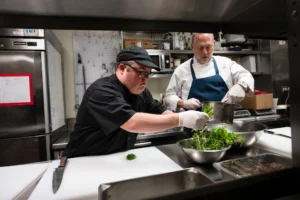
For three Halloweens in a row, Joseph Valentino was Emeril Lagasse.
He wasn’t the only kid in New Jersey who idolized chefs and wanted to be one when he grew up. For Mr. Valentino, though, the dream seemed especially hard to reach. Diagnosed with autism as a toddler, he still hadn’t spoken by age 5, when he first dressed as Emeril.
Today, at 27, he is a cook at Point Seven restaurant in Manhattan, working the cold food, pastry and raw bar stations, sometimes all at once. He says the path he took to get there was strewn with rejection. There were interviews that went nowhere, jobs in kitchens where he never felt welcome, deep periods of depression.
“I viewed myself as a liability,” he said.
His career is one of the inspirations for a new program, Chefs on the Spectrum, meant to train and place people with autism in fine-dining jobs.
Mr. Valentino and the owner of Point Seven, the chef Franklin Becker, introduced the initiative Tuesday night during a $2,500-a-head fund-raiser for the nonprofit organization Autism Speaks at Cipriani Wall Street in Lower Manhattan.
Mr. Becker, who is on the group’s board, pitched his Chefs on the Spectrum idea to the rest of the board as a way to help address two problems at the same time: the shortage of skilled labor in restaurants and a high unemployment rate among autistic adults.
Professional kitchens have long been known as havens for people with neurological and developmental disabilities. Chefs who describe themselves as dyslexic include Marco Pierre White, Jamie Oliver and Marc Murphy. Cooks who say they have some form of attention deficit can seem to outnumber those without.
But people on the autism spectrum have an exceedingly low profile in the business, whether because they haven’t been diagnosed or choose not to disclose it.
“I still haven’t met anybody with autism in the kitchen,” said Mr. Valentino, who cooked in cafeterias and catering kitchens before going to work for Mr. Becker last year. “I think that needs to be fixed, and I think this program will fix it.”
There are other initiatives that place people on the spectrum into hospitality jobs. Several coffee chains, including Bitty & Beau’s, which has 13 locations in the United States, are dedicated to employing people with intellectual and developmental disabilities.
Chefs on the Spectrum is still taking shape, but it is likely that some of its training will be based on Mr. Valentino’s experience of navigating professional kitchens. He will try to answer questions about how they can work with people with autism. And he hopes that his career will help change views of autism.
